New study claims the East Midlands can lead the UK’s hydrogen revolution through investment in workforce skills
The East Midlands is uniquely positioned to lead the UK’s …
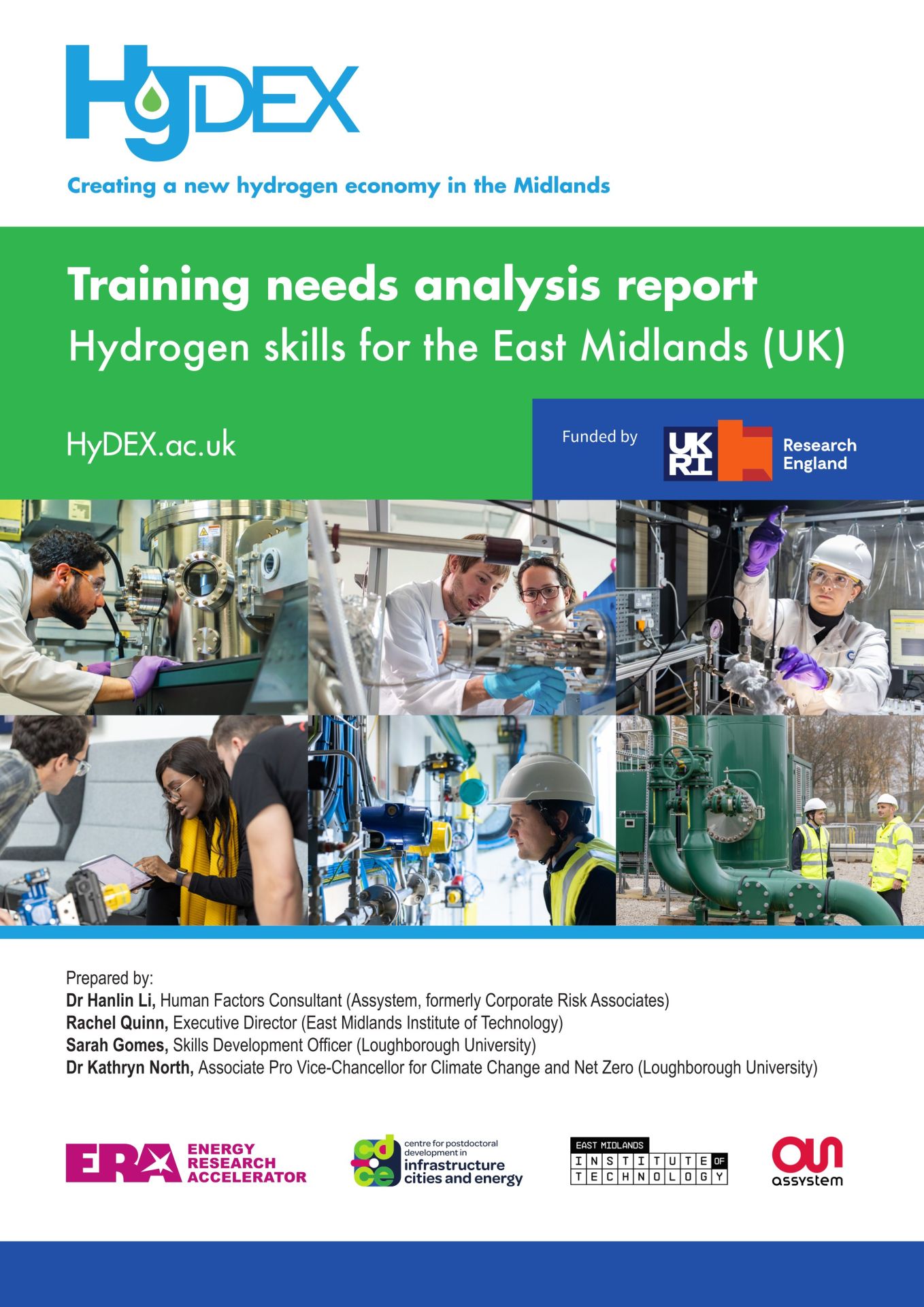
The East Midlands is uniquely positioned to lead the UK’s hydrogen revolution, but only if urgent investment is made in workforce skills, according to a major new study published by the Energy Research Accelerator’s HyDEX programme, together with the East Midlands Institute of Technology and Centre for Postdoctoral Development in Infrastructure and Energy (C-DICE).
The East Midlands is already home to the UK’s largest industrial hydrogen demand cluster, currently with 10 TWh of projected annual demand from more than 20 businesses by 2040. However, without the right workforce in place, the region may struggle to deliver on this potential.
The report, Hydrogen Skills for the East Midlands, sets out a comprehensive analysis of the current and future workforce requirements for the emerging hydrogen sector. It warns that despite growing industrial demand, there is a significant gap between the skills employers need and the training currently available, risking lost investment, delayed projects, and a shortfall in the region’s contribution to net-zero targets.
“The next decade is critical for addressing climate change,” the report states. “The rapid development of a low-carbon hydrogen economy can accelerate the transformation of the energy sector and play a crucial role in reducing emissions and improving energy efficiency.”
The study, commissioned by HyDEX, is designed to support the East Midlands in becoming a national centre of excellence for hydrogen, both in terms of production and skills. Its findings will guide the development of new education and training pathways and influence curriculum reform across schools, colleges, and universities.
Key recommendations include:
- The need for investment in accessible and industrial focused hydrogen training.
- Embedding hydrogen-related skills into existing qualifications such as T-levels, apprenticeships, and degrees, alongside the creation of new technical and vocational routes.
- Launching a Hydrogen Transition Leadership Programme to support senior managers and business leaders in planning and implementing hydrogen-related projects.
- Improving collaboration between education providers, industry, and local authorities to ensure that training provision remains relevant and responsive to market needs.
- Raising public and stakeholder awareness of hydrogen technologies to support planning, safety, and community engagement.
The report also highlights the need to urgently address gaps in training related to hydrogen safety, regulation, storage, and logistics. Many companies surveyed said they were unable to find candidates with the necessary technical knowledge, and were instead adapting existing engineering or managerial roles to cover hydrogen responsibilities, often without sufficient training or clarity.
“The East Midlands is ready to become a major player in the UK’s hydrogen economy,” said Rachel Quinn, Executive Director of the East Midlands Institute of Technology. “But without the skilled people to deliver, we risk falling behind. This report sets out the urgent actions needed to build a workforce that can power a hydrogen future.”
Dr Kathryn North, Associate Pro Vice-Chancellor for Climate Change and Net Zero at Loughborough University, added: “This research confirms what industry has been telling us, the talent pipeline is not yet fit for purpose. We need to equip learners, workers, and leaders with the skills and confidence to thrive in the hydrogen economy.”
The report was developed through an extensive programme of research, including:
- A review of hydrogen-related job market trends and recruitment activity in the East Midlands.
- Engagement with regional employers and hydrogen industry stakeholders.
- An assessment of existing training and education provision for hydrogen content.
Read more on the HyDEX website: https://hydex.ac.uk/hydrogen-skills-training-needs-analysis-for-the-east-midlands/
Download the full report here: https://hydex.ac.uk/wp-content/uploads/2025/08/HyDEX-hydrogen-training-needs-and-skills-report-300725.pdf
ENDS
More information?
For more information, please contact Nick King, Marketing and Communications Manager for the Energy Research Accelerator and HyDEX on nick.king@era.ac.uk
Notes to Editors:
About the Energy Research Accelerator (ERA):
The Energy Research Accelerator brings together eight Midlands universities and the British Geological Survey, along with and key industry partners to accelerate energy innovation. ERA supports research, development, and demonstration of low-carbon technologies and provides world-class facilities and expertise across hydrogen, energy storage, smart systems, and more. ERA is part of Midlands Innovation and plays a key role in helping the UK reach net-zero targets.
Website: www.era.ac.uk
About HyDEX:
HyDEX (Hydrogen Development and Knowledge Exchange) is a programme led by the Energy Research Accelerator. It aims to support the development of the hydrogen economy in the Midlands by connecting universities, businesses, and public sector partners. HyDEX helps companies access hydrogen R&D capabilities and expertise, and works to develop the skills base needed to grow this critical green industry.
Website: www.hydex.ac.uk
About Loughborough University:
Loughborough University is one of the UK’s leading institutions for research and innovation in clean energy and net zero technologies. The university is a founding member of ERA and a core partner in HyDEX, leading on skills for both programmes. It is internationally recognised for expertise in hydrogen safety, transport technologies, climate resilience, and engineering education.
Website: www.lboro.ac.uk
About the East Midlands Institute of Technology (EMIoT):
The East Midlands Institute of Technology is a government-backed partnership between Loughborough University, the University of Derby, Loughborough College and Derby College Group. EMIoT focuses on delivering high-quality technical education and training in key growth areas such as hydrogen, low-carbon energy, advanced manufacturing, and digital technologies, supporting regional economic development and net-zero goals.
Website: www.emiot.ac.uk